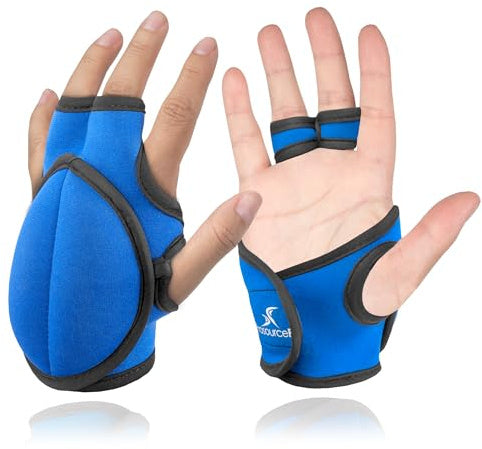
Weighted gloves for hand tremors are among the most commonly encountered assistive options when people first research tremor management. But do they actually reduce shaking, or do they simply feel like they should? This article examines the mechanism, the clinical evidence, the practical limits, and what alternatives the research supports. Essential Tremor and Parkinson's Disease are the two conditions most relevant to this search.
What Are Weighted Gloves for Tremors?
Weighted gloves are fingerless or open-palm wearables with small weights embedded in or attached to the back of the hand. Weights typically range from a fraction of a pound up to approximately 1.5 pounds per glove. Common materials include neoprene, lycra, and polyester; most use a Velcro strap closure. They are not electronic, require no charging, and are designed for use during daily tasks such as eating, writing, and dressing. These are passive, weight-based devices, not magnetic stabilization or neurostimulation devices; the distinction matters when evaluating clinical evidence.
How Weighted Gloves Are Thought to Reduce Tremor
The proposed mechanism is mechanical: added weight on the hand increases the inertia of the limb, which may reduce the amplitude of involuntary shaking. A second proposed mechanism involves proprioceptive feedback, where the sensation of added weight may improve the brain's awareness of hand position and reduce unintended movement. Neither mechanism eliminates the neurological source of tremor; the effect, when present, is symptomatic management only. There is currently no cure for Essential Tremor or Parkinson's Disease; all weighted devices are management tools only.
What Does the Research Actually Show?
Published occupational therapy research, including work in the American Journal of Occupational Therapy, has examined wrist weights and weighted cuffs for tremor in adults with neurological conditions and found some reduction in tremor during eating tasks. The evidence base is limited: most studies are small, short-term, and focus on functional tasks rather than objective tremor measurement. Effects are more consistently observed during specific tasks than in general tremor suppression. Effects vary significantly by tremor type; action tremors common in Essential Tremor may respond differently than resting tremors more characteristic of Parkinson's Disease. Consult a neurologist or occupational therapist before selecting any device.
Weighted Gloves for Essential Tremor
Essential Tremor is a neurological condition causing involuntary, rhythmic shaking that typically occurs during intentional movement, known as an action tremor. This type of tremor tends to be most disruptive during tasks requiring hand steadiness, which is why weighted devices have been studied in this population. Some users report noticeable improvement in task performance while wearing weighted gloves; others report minimal benefit. There is currently no cure for Essential Tremor; weighted gloves represent one management tool among several, including medication, focused ultrasound, and assistive devices. Consult a neurologist or occupational therapist before choosing.

Weighted Gloves for Parkinson's Disease
Parkinson's Disease produces a resting tremor, which typically appears when the hand is at rest and may diminish during intentional movement. This is mechanically different from the action tremors common in Essential Tremor, which means weighted gloves may behave differently across the two conditions. Some occupational therapists use weighted tools in Parkinson's Disease management; however, evidence is less robust than for Essential Tremor. Primary treatments for Parkinson's Disease tremors include medication and, in appropriate cases, deep brain stimulation; there is currently no cure for Parkinson's Disease. A movement disorder specialist is best positioned to advise on the role of assistive devices in an individual's plan.
Practical Limits of Weighted Gloves
Weighted gloves are most effective during specific tasks and for limited durations; most sources recommend no more than 30 minutes of continuous use. Prolonged use can cause hand and arm fatigue, which may worsen rather than manage functional performance. Skin irritation and pressure discomfort are reported by some users, particularly with neoprene materials. Heavier gloves may restrict fine motor movement, reducing practical benefit for detailed tasks like writing or using a touchscreen. Individual tremor severity and type substantially affect how much benefit a given weight produces; the response is not predictable without individual assessment.
How to Choose the Right Weight and Fit
Lighter weights in the quarter-pound to half-pound range are generally recommended as a starting point; heavier gloves are not automatically more effective and can cause significant fatigue. Proper fit is critical; a glove that slips during use provides no consistent inertial benefit, and one that is too tight may impair circulation. Measure hand circumference before purchasing, as sizing varies substantially across brands. An occupational therapist can recommend appropriate weight, duration, and task context based on individual tremor assessment. Adjustable strap closures are preferable for patients with limited dexterity.
How Passive Magnetic Stabilization Differs From Weighted Gloves
Weighted gloves work through inertial loading; the Steadi-3 uses a different mechanism entirely: passive magnetic stabilization, in which internal magnets counteract tremor motion without adding significant bulk or requiring batteries. The Steadi-3 is an FDA-registered Class I medical device and has been studied in a placebo-controlled clinical trial; 84% of users in that study showed improved tremor control compared to no device. Unlike weighted gloves, the Steadi-3 does not rely on muscle loading or proprioceptive feedback; its mechanism is mechanical dampening through magnetic counterforce. For patients evaluating options, discussing mechanism with a healthcare provider helps match device type to individual tremor characteristics.
Other Assistive Devices for Hand Tremors
Weighted utensils, adaptive spoons, forks, and writing instruments, use the same inertial principle as weighted gloves but are task-specific. Wrist-worn inertial devices apply load at the wrist rather than the hand; effect distribution differs from back-of-hand weight placement. Orthoses and splints limit range of motion to reduce tremor expression during specific tasks. Gyroscopic and magnetic stabilization devices represent a newer category working through active or passive counterforce rather than inertial loading. An occupational therapist can match assistive device type to individual task goals and tremor characteristics.
When to Talk to a Doctor or Occupational Therapist
Weighted gloves are available without a prescription and are often self-selected; however, tremor type and severity should ideally be assessed before choosing any device. A neurologist or movement disorder specialist can identify whether tremor is action-based, resting, or mixed, which directly affects which device categories are likely to be useful. An occupational therapist can conduct functional assessments and recommend specific weights, durations, and tasks where assistive devices are most beneficial. If tremor is progressively worsening or significantly affecting daily function, assessment for medication, surgical, or clinical trial options is appropriate. There is currently no cure for Essential Tremor or Parkinson's Disease.
Tips for Using Weighted Gloves Effectively
Start with the lightest available weight and evaluate functional improvement during a specific target task before increasing weight. Limit continuous wear to approximately 30 minutes; remove gloves during rest periods to prevent hand fatigue. Pair use with a specific functional goal, such as improving stability during eating or writing, rather than wearing throughout the entire day. Wash according to manufacturer instructions; allow thorough drying before reuse to maintain fit integrity. Monitor for skin irritation, particularly at strap points, and consult an occupational therapist if discomfort persists.
What the research says about weighted gloves for hand tremors
Weighted gloves for hand tremors may provide real functional benefit for some patients during specific tasks, but the evidence base is limited and results vary by tremor type, severity, and individual response. They are management tools only; there is no cure for Essential Tremor or Parkinson's Disease. For patients evaluating options, professional consultation is the recommended starting point. Choosing the right assistive device, one that matches an individual's tremor type, severity, and daily activity demands, is a process that benefits from the guidance of a neurologist or occupational therapist.