Weighted gloves for Essential Tremor are among the first assistive tools patients encounter when researching hand tremor management. Many people try them before exploring other options. This article evaluates what they actually do, where they fall short, and what alternatives the research supports. There is currently no cure for Essential Tremor; assistive devices help manage its impact on daily life.
What are weighted gloves and how do they work?
Weighted gloves for hand tremors add mass to the back of the hand or wrist. The principle: a heavier limb requires more force to move, which may reduce the amplitude of small, involuntary tremor movements. The mechanism is entirely passive; there are no electronics, no adjustment, and no batteries. Most are available over the counter and typically range from 0.25 lb to 1.5 lb per glove. They are not purpose-built medical devices in most cases; many were originally designed for fitness use and have been repurposed for tremor management.
What conditions are weighted gloves used for?
Weighted gloves are used for action tremors, tremors that occur during movement, which is the primary presentation in Essential Tremor. They are also explored for Parkinson's Disease tremors and MS-related tremors, though mechanisms and effectiveness differ by condition. Essential Tremor is a neurological condition with no known cure; management tools aim to reduce impact on daily tasks like writing, eating, and handling objects. Consulting a neurologist or occupational therapist before selecting any device is recommended, as individual tremor type significantly affects which options are likely to be useful.
Pros of weighted gloves for Essential Tremor
Weighted gloves are affordable and widely accessible; most options cost between $20 and $200 and are available without a prescription. They are simple to use: no charging, no calibration, no setup required before any activity. They can be tried at home without a fitting appointment, though occupational therapist guidance improves results. Published occupational therapy practice and peer-reviewed literature suggest they may provide meaningful tremor amplitude reduction for mild to moderate Essential Tremor during short-duration tasks such as eating, writing, or holding objects.
Cons and limitations of weighted gloves
Added weight causes hand and wrist fatigue, particularly during extended wear or repeated use throughout the day. Bulk can interfere with fine motor tasks, including typing, buttoning, and using a phone, reducing practical usefulness for many daily activities. Results are inconsistent: some users report noticeable improvement; others report little change; the benefit is not predictable across individuals. Fixed weight does not adapt to changes in tremor intensity; a tremor that worsens mid-task receives the same passive resistance as a mild tremor. Comfort varies with material: neoprene retains heat; lycra or open-palm designs improve breathability.
How to choose the right weight and fit
Occupational therapists typically recommend beginning with lighter options in the 0.25 to 0.5 lb range and increasing only if tolerated without fatigue. Weight distribution matters: gloves that concentrate weight on the back of the hand tend to perform better for action tremors than those with wrist-only weight. Measure palm circumference for gloves sold by size; one-size designs may not accommodate all hand proportions. Fit should be snug but not restrictive; excessive compression can worsen discomfort over time. Consult an occupational therapist for individualized weight selection and fitting.

When do weighted gloves stop being enough?
Weighted gloves are often described as an entry-level option, appropriate when tremors are mild and short-duration tasks remain manageable with light assistance. Signs that a weighted glove may no longer be sufficient include tremor worsening mid-task, fatigue limiting how long the glove can be worn, and inability to complete tasks even while wearing the glove. At this stage, exploring anti-tremor gloves and other assistive devices with different mechanisms becomes relevant. A neurologist or occupational therapist can help evaluate whether the current approach is still meeting the patient's functional needs.
What are the alternatives to weighted gloves for Essential Tremor?
Pharmaceutical options: propranolol and primidone are the most commonly prescribed medications for Essential Tremor; effectiveness varies and side effects exist. Surgical options: deep brain stimulation and focused ultrasound are available for severe, medication-resistant cases; not appropriate for mild to moderate tremor. Adaptive utensils and wrist weights are simpler, lower-cost alternatives for specific tasks such as eating and writing without full-hand coverage. Wearable devices using different stabilization mechanisms, including tuned mass dampers, represent a distinct device category with different performance characteristics. No single option works for everyone; a healthcare provider should guide selection.
How passive magnetic stabilization differs from weighted gloves
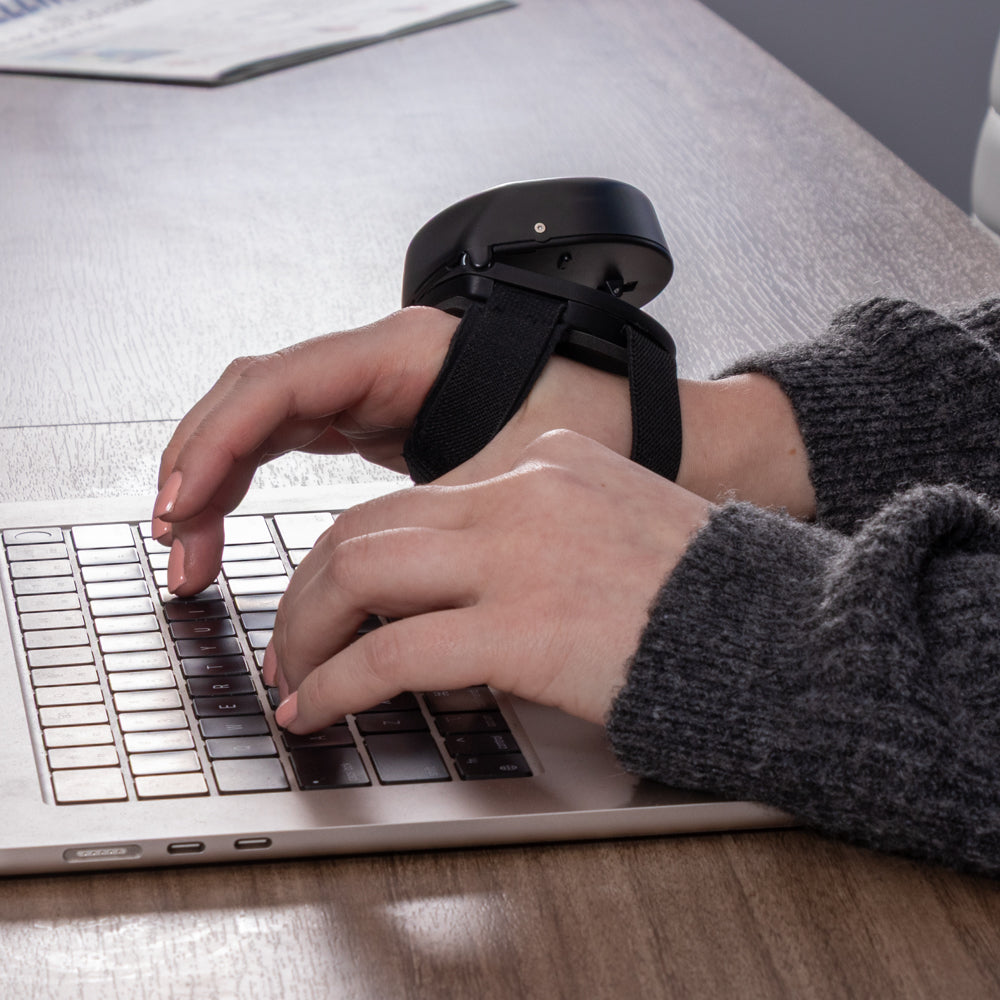
The Steadi-3 is not a weighted glove; it uses passive magnetic stabilization, a different mechanism. Where weighted gloves add static mass, the Steadi-3 uses a magnetic tuned mass damper that moves in response to the user's own tremor, generating a counterforce. It is an FDA-registered Class I medical device, distinguishing it from over-the-counter fitness gloves repurposed for tremor use. Battery-free and requiring no charging, calibration, or prescription. In a placebo-controlled study, 84% of users experienced improved tremor control. For patients who have tried weighted gloves without adequate relief, discussing devices with a different stabilization mechanism with a healthcare provider may be appropriate.
What does the research say about weighted gloves?
A peer-reviewed study published in the American Journal of Occupational Therapy found that weighted wrist cuffs reduced tremor during eating tasks in adults with stable brain lesions. A 2024 review in Tremor and Other Hyperkinetic Movements noted that weighted utensils and gloves may reduce tremor amplitude through added mass, but results vary between individuals. The International Essential Tremor Foundation notes that weighted pens and gloves are commonly recommended by occupational therapists as first-line assistive tools. The research base is moderate; weighted gloves are widely used in occupational therapy practice despite limited large-scale controlled trials.
Are there risks or side effects to using weighted gloves?
Prolonged wear can create wrist and joint strain, particularly in users with pre-existing conditions such as arthritis. The additional load on already fatigued or weakened hands may accelerate muscle fatigue rather than reducing it over extended periods. Overuse or incorrect weight selection may worsen discomfort rather than improve tremor management. No serious adverse events are typically associated with appropriate use; risks are largely related to comfort and misapplication. Consulting an occupational therapist for proper fitting and a recommended wear schedule reduces these risks. Users with joint conditions should seek medical guidance before starting weighted glove use.
Practical tips for using weighted gloves effectively
Use weighted gloves for specific high-difficulty tasks such as meals and writing sessions rather than wearing them all day; this reduces fatigue and extends effective use time. Start with the lowest available weight and increase only if the lighter option provides insufficient stabilization without causing fatigue. Check material composition: some gloves contain latex in finger loops, which is relevant for users with latex sensitivities. Hand-wash or wipe with a damp cloth rather than machine washing to preserve weight distribution. Track whether tremor management improves over two to four weeks of consistent task-specific use; if not, consult an occupational therapist.
Weighted gloves for Essential Tremor: a practical conclusion
Weighted gloves for Essential Tremor are a practical, accessible starting point for mild tremor management; low cost, battery-free, and easy to use. Their limitations, including inconsistent results, hand fatigue, and inability to adapt to changing tremor intensity, mean they are not appropriate for all patients or all stages of tremor progression. Alternatives exist across a spectrum from medication and surgery to wearable devices using different stabilization mechanisms. Healthcare providers and occupational therapists are the best guides for selecting the approach that matches an individual's tremor severity, daily needs, and goals. The goal of all these tools is control over daily tasks and maintenance of independence.