The early warning signs of Parkinson's are easy to miss. Many first signs — loss of smell, a subtle tremor, mood shifts — appear years before diagnosis, dismissed as stress or aging. This guide covers all 12 warning signs of Parkinson's Disease, explains how Parkinson's begins, and walks through the prodromal and early Parkinson's Disease early symptoms most lists overlook.
Why Early Detection Matters in Parkinson's Disease
By the time a visible tremor appears, Parkinson's Disease has usually been developing for years — sometimes decades. Research suggests up to 60% of the brain's dopamine-producing neurons may already be lost before motor symptoms become diagnosable. The early warning signs of Parkinson's are real during this prodromal phase but easily attributed to stress or aging. Early diagnosis isn't a cure — it means earlier access to treatments that preserve function. Understanding how Parkinson's begins is the first step.
Who Is Most at Risk of Developing Parkinson's Disease?

Knowing who's most likely to develop Parkinson's helps explain why recognizing the warning signs of Parkinson's Disease matters at certain ages. Risk rises after age 60, is slightly higher in men, and increases with family history of Parkinson's or Essential Tremor. Pesticide exposure and repeated head injuries are documented environmental risk factors. Understanding the early stages of Parkinson's Disease within these risk groups makes the early warning signs of Parkinson's more meaningful — and worth taking seriously when they appear.
Warning Signs 1–3: Motor Symptoms That Often Go Unnoticed
The first signs of Parkinson's Disease are often motor but subtle, typically beginning on one side of the body.
Sign 1 — resting tremor:
Appears when the hand is still, often in one thumb, finger, or chin.
Sign 2 — micrographia:
Handwriting becomes smaller and more cramped, crowding together across the line.
Sign 3 — reduced arm swing:
One arm stays close to the body while the other swings normally while walking.
Warning Signs 4–6: Non-Motor Signals That Can Appear Years Before Diagnosis
Some prodromal Parkinson's symptoms aren't motor at all — alpha-synuclein accumulates in the olfactory bulb and autonomic nervous system years before reaching movement regions.
Sign 4 — loss of smell:
Present in up to 90% of early cases; Johns Hopkins notes unexplained anosmia carries a 50% lifetime Parkinson's risk.
Sign 5 — REM sleep behavior disorder:
Acting out dreams physically during sleep.
Sign 6 — chronic constipation:
Unexplained by diet, reflecting slowed gut motility.
Warning Signs 7–9: Movement and Facial Changes You Might Attribute to Aging
These Parkinson's Disease early symptoms are often written off as aging. All three result from bradykinesia — the slowing of movement caused by dopamine loss.
Sign 7 — facial masking (hypomimia):
Flat expression and reduced blinking, dropping from 16–18 blinks per minute to just 1–2.
Sign 8 — softer, monotone voice:
Quieter speech with less pitch variation.
Sign 9 — slow or shuffling walk:
Shortened strides, slight forward stoop, and small-step turns.
Warning Signs 10–12: Mood, Cognitive, and Autonomic Changes
Most lists of early signs of Parkinson's Disease stop at 10. These last three are the most often overlooked — and the reason diagnoses are missed for years.
Sign 10 - late-onset depression
Without a clear life cause, driven by dopamine loss affecting mood regulation.
Sign 11- increased anxiety
Particularly in new or unfamiliar situations, rooted in neurochemistry rather than circumstance.
Sign 12 - slowed thinking or word-finding difficulty
A subtle non-motor feature — not dementia.
The Red Flag Pattern — Why One Sign Isn't Enough
Any single warning sign of Parkinson's Disease may have another explanation. Constipation is common, loss of smell can follow a virus, mild anxiety has dozens of causes. The risk profile changes when three or more signs appear together — especially asymmetrically, since Parkinson's almost always begins on one side. Three or more signs, particularly a motor plus a non-motor sign, warrants evaluation by a movement disorder neurologist, who can perform a UPDRS assessment or DaTscan.
Early vs. Later Parkinson's: How the Signs Change Over Time
The early signs of Parkinson's Disease look different from later-stage symptoms — which is part of why early detection matters. The first signs of Parkinson's Disease are subtle and one-sided: a faint tremor, smaller handwriting, softer voice. As the condition progresses, signs become bilateral and more visible — balance issues, freezing of gait, cognitive changes. Recognizing prodromal Parkinson's symptoms early means intervening before these Parkinson's Disease early symptoms reach the stage where they limit independence.
Why Early Parkinson's Signs Get Dismissed as Normal Aging
Constipation, stiffness, softer voice, mild depression, slower movement — each is easily attributed to aging, stress, or general decline. They don't alarm most people, and often don't alarm general practitioners either. That's why understanding how does Parkinson's start matters: the early signs look like aging until you see them together. The 10-year prodromal window means signs may appear in someone's 50s while diagnosis waits until their 60s — caregivers often notice first.
What to Do If You Notice These Warning Signs
If you're noticing three or more of the early warning signs of Parkinson's — especially a mix of motor and non-motor signs — request a referral to a movement disorder neurologist, not a general practitioner. Bring a written list: symptoms, onset dates, whether signs are one-sided, and family history. The assessment typically includes a UPDRS evaluation. The Parkinson's Foundation and Michael J. Fox Foundation offer referral guidance and caregiver resources.
Managing Parkinson's Tremors While You Navigate Diagnosis and Treatment

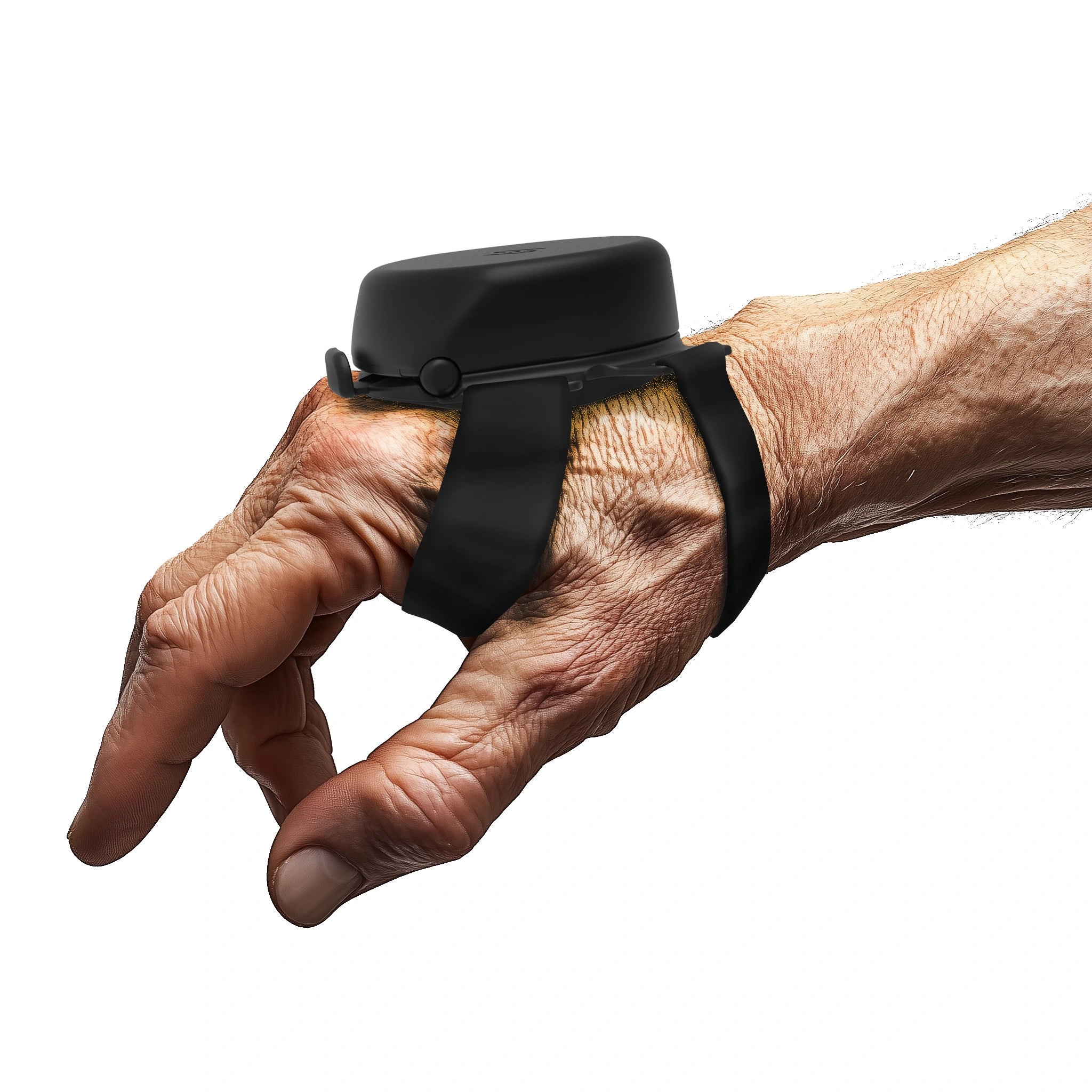
The gap between noticing symptoms and finding a medication protocol that works can last months or years. During that time, hand tremors interfere with eating, writing, and drinking — the daily tasks that shape independence. The Steadi-3 tremor glove for Parkinson's Disease provides immediate hand stabilization — no prescription, no battery, no waiting. Validated in a placebo-controlled clinical study showing improved tremor control in 84% of participants, it fills the gap for day-to-day Parkinson's tremor management.
Conclusion
Parkinson's Disease gives warning — often years in advance — through subtle signs easily mistaken for aging or stress. The 12 early warning signs of Parkinson's covered here range from resting tremor and reduced arm swing to loss of smell, REM sleep behavior disorder, and late-onset depression. The pattern matters more than any single sign: three or more, especially on one side of the body, is the threshold for evaluation. See our complete Parkinson's Disease symptoms guide.